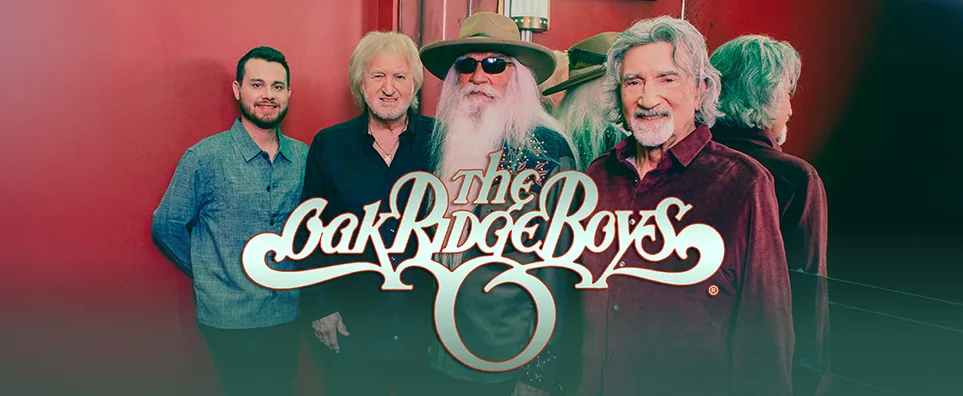
Oak Ridge Boys
-
DateJun 05, 2026
-
Event Starts7:30pm
-
Doors Open6:30pm
-
Ticket Prices$39.95 - 89.95
(plus tax & fees) -
AvailabilityOn Sale Now
-
LocationBlue Gate PAC
760 S Van Buren St
Shipshewana, IN 46565
-
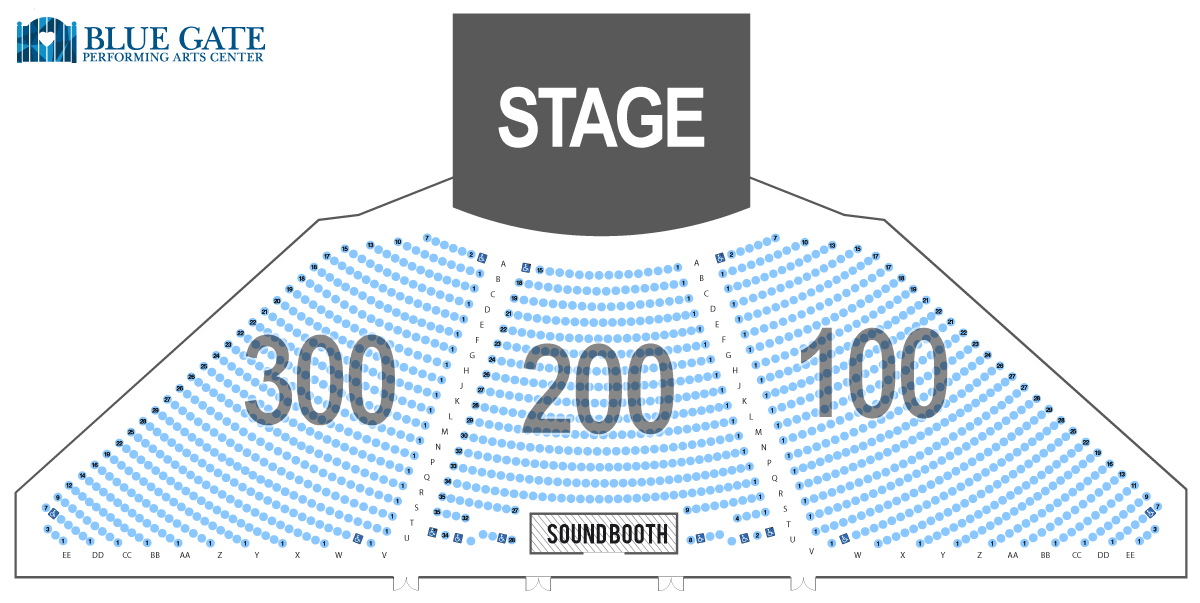
Seating ChartView Seating Chart (If you are paying with a gift card, you must call to purchase tickets 260.768.4725)
Jun 05, 2026
Friday @ 7:30pm
Event Details
One of the longest-running groups in country music, the Oak Ridge Boys started life as a gospel quartet before gradually modernizing their style and moving into secular country-pop. Yet even at the height of their popularity in the late '70s and early '80s -- when they were big enough to cross over to the pop charts -- their sound always remained deeply rooted in country gospel harmony. Their existence dates all the way back to World War II, circa 1942-1943, when a Knoxville, Tennessee group began performing gospel songs in nearby Oak Ridge, the home of an atomic bomb research facility. The group's members also performed in a larger aggregation called Wally Fowler & the Georgia Clodhoppers, who recorded for Capitol. However, lead singer Fowler decided to focus on gospel music in 1945. Dubbed the Oak Ridge Quartet, the group first appeared at the Grand Ole Opry that year and made their first recordings in 1947 with a lineup of Fowler, Lon "Deacon" Freeman, Curly Kinsey, and Johnny New.
Numerous personnel shifts ensued over the next few years, particularly in 1949 when the entire group split from Fowler; at that point, he hired a completely different band, the Bob Weber-led Calvary Quartet, to assume the Oak Ridge name. With a core of Fowler and Weber, plus a revolving-door cast of supporting vocalists, the group became one of the top draws on the Southern gospel circuit, continuing to the end of 1956. At that point, Fowler disbanded the quartet and sold the name to group member Smitty Gatlin, who organized a new lineup in early 1957. In 1961, Gatlin changed their name to the Oak Ridge Boys, made them a full-time professional act, and started to modernize their sound on record with fuller arrangements and elements of country and folk. Future mainstay William Lee Golden joined as the group's baritone vocalist in 1964, and when Gatlin retired to become a full-time minister two years later, the group, acting on Golden's recommendation, hired ex-Southernairs singer Duane Allen as his replacement on lead vocals.
With bass singer Noel Fox and tenor singer Willie Wynn, the Oak Ridge Boys continued to broaden their appeal by adapting their sound to the times, adding a drummer to their backing band and incorporating bits of pop and even rock into their country-gospel style. As a result, they grew into one of the most popular gospel acts of the late '60s, despite purist criticism over their secular influences and long-haired image. They even won their first Grammy in 1970 for "Talk About the Good Times." Fox and Wynn were replaced by Richard Sterban (ex-Keystone Quartet) and Philadelphia native Joe Bonsall in 1972 and 1973, respectively, and this lineup would remain intact for the next decade-and-a-half. In 1973, they recorded a single with Johnny Cash and the Carter Family called "Praise the Lord and Pass the Soup," which brought them their first appearance on the country charts. In 1975, they opened a series of tour dates for Roy Clark, whose manager was highly impressed and encouraged them to try their hand at secular country.
The Oak Ridge Boys signed with Columbia later that year but found the initial transition a rough one: they split their time between country and gospel, and without a strong identity their sales dropped. The resulting financial problems nearly forced them to disband, and a discouraged Columbia gave up on them after their 1976 single, "Family Reunion," barely charted, even though labelmate Paul Simon had tapped them to sing backup on his hit "Slip Slidin' Away." Fortunately, they got another chance with MCA and scored a breakout Top Five hit in 1977 with "Y'all Come Back Saloon," the title song from their label debut. The follow-up, "You're the One," reached number two, and their next album, 1978's Room Service, gave them their first number one hit in "I'll Be True to You" as well as two more Top Five hits in "Cryin' Again" and "Come on In."
Thus established as country hitmakers, the Oak Ridge Boys embarked on a run of chart success that would last through the '80s. Golden stopped cutting his hair and beard altogether, giving the group a hugely recognizable visual signature, as well. They hit number one again in 1980 with "Trying to Love Two Women," but it was the following year that would make them a genuine phenomenon. Their recording of "Elvira," an obscure, doo wop-style novelty song from the '60s, became a major, Grammy-winning crossover smash. Not only did it hit number one on the country charts, but its infectious "oom-pop-a-mow-mow" bass vocal hook boosted it into the Top Five on the pop charts. Its accompanying album, Fancy Free, became their first to top the country charts, not to mention their biggest seller to date. The title cut of their chart-topping 1982 follow-up, Bobbie Sue, also went number one country and nearly made the pop Top Ten as well. American Made's title track also topped the charts in 1983, as did its follow-up, "Love Song." In early 1984, Deliver became their third number one country album and landed two more number one singles that year with "Everyday" and "I Guess It Never Hurts to Hurt Sometimes." 1985 brought three number ones: "Little Things," "Make My Life with You," and "Touch a Hand, Make a Friend."
The Oak Ridge Boys' sales began to slow a bit in the latter half of the '80s, but they still produced big hits with regularity. They hit number one in 1987 ("It Takes a Little Rain," "This Crazy Love"), 1988 ("Gonna Take a Lot of River"), and 1990 ("No Matter How High"), giving them a total of 16 career country chart-toppers (and 29 Top Ten hits). However, by that point, the group's longtime lineup had split --Golden , whose mountain-man appearance was increasingly supported by his rugged lifestyle, was given the boot in 1987 in an attempt to remake the group's image. He was replaced by longtime backing-band guitarist Steve Sanders and sued his former bandmates, eventually settling out of court. In 1991, the Oak Ridge Boys parted ways with MCA and signed with RCA, but after just two albums, it was apparent that their commercial prime had passed, and the relationship ended. The group returned to traditional-style country gospel on occasion during the '90s and continued to tour.
Meanwhile, Sanders' marital problems worsened, causing him to leave the group in late 1995; Golden and the other members resolved their differences, and he returned at their New Year's Eve show that year; they still performed often, notably in Branson, Missouri. Sadly, Sanders shot and killed himself in 1998. Fox, who moved on to run the group's publishing arm and later became a high-ranking music executive, passed away in April 2003. The group, with its classic '70s lineup of Sterban, Bonsall, Golden, and Allen, released a new studio album, The Boys Are Back, which featured reimagined versions of songs by John Lee Hooker, Neil Young, and the White Stripes, in 2009. The Oak Ridge Boys turned their focus on recording spiritual albums for Gaither Music Group, but would continue to perform secular shows, including one for a 40th anniversary celebration in 2013. The Oak Ridge Boys were inducted into the Country Music Hall of Fame in 2015. Early 2018 saw the release of the single "Brand New Star" ahead of the arrival of the Dave Cobb-produced full-length 17th Avenue Revival, which dropped later that March. The following year, the band also pegged Cobb to produce their eighth holiday set, Down Home Christmas. ~ Steve Huey & Steve Leggett, Rovi
Numerous personnel shifts ensued over the next few years, particularly in 1949 when the entire group split from Fowler; at that point, he hired a completely different band, the Bob Weber-led Calvary Quartet, to assume the Oak Ridge name. With a core of Fowler and Weber, plus a revolving-door cast of supporting vocalists, the group became one of the top draws on the Southern gospel circuit, continuing to the end of 1956. At that point, Fowler disbanded the quartet and sold the name to group member Smitty Gatlin, who organized a new lineup in early 1957. In 1961, Gatlin changed their name to the Oak Ridge Boys, made them a full-time professional act, and started to modernize their sound on record with fuller arrangements and elements of country and folk. Future mainstay William Lee Golden joined as the group's baritone vocalist in 1964, and when Gatlin retired to become a full-time minister two years later, the group, acting on Golden's recommendation, hired ex-Southernairs singer Duane Allen as his replacement on lead vocals.
With bass singer Noel Fox and tenor singer Willie Wynn, the Oak Ridge Boys continued to broaden their appeal by adapting their sound to the times, adding a drummer to their backing band and incorporating bits of pop and even rock into their country-gospel style. As a result, they grew into one of the most popular gospel acts of the late '60s, despite purist criticism over their secular influences and long-haired image. They even won their first Grammy in 1970 for "Talk About the Good Times." Fox and Wynn were replaced by Richard Sterban (ex-Keystone Quartet) and Philadelphia native Joe Bonsall in 1972 and 1973, respectively, and this lineup would remain intact for the next decade-and-a-half. In 1973, they recorded a single with Johnny Cash and the Carter Family called "Praise the Lord and Pass the Soup," which brought them their first appearance on the country charts. In 1975, they opened a series of tour dates for Roy Clark, whose manager was highly impressed and encouraged them to try their hand at secular country.
The Oak Ridge Boys signed with Columbia later that year but found the initial transition a rough one: they split their time between country and gospel, and without a strong identity their sales dropped. The resulting financial problems nearly forced them to disband, and a discouraged Columbia gave up on them after their 1976 single, "Family Reunion," barely charted, even though labelmate Paul Simon had tapped them to sing backup on his hit "Slip Slidin' Away." Fortunately, they got another chance with MCA and scored a breakout Top Five hit in 1977 with "Y'all Come Back Saloon," the title song from their label debut. The follow-up, "You're the One," reached number two, and their next album, 1978's Room Service, gave them their first number one hit in "I'll Be True to You" as well as two more Top Five hits in "Cryin' Again" and "Come on In."
Thus established as country hitmakers, the Oak Ridge Boys embarked on a run of chart success that would last through the '80s. Golden stopped cutting his hair and beard altogether, giving the group a hugely recognizable visual signature, as well. They hit number one again in 1980 with "Trying to Love Two Women," but it was the following year that would make them a genuine phenomenon. Their recording of "Elvira," an obscure, doo wop-style novelty song from the '60s, became a major, Grammy-winning crossover smash. Not only did it hit number one on the country charts, but its infectious "oom-pop-a-mow-mow" bass vocal hook boosted it into the Top Five on the pop charts. Its accompanying album, Fancy Free, became their first to top the country charts, not to mention their biggest seller to date. The title cut of their chart-topping 1982 follow-up, Bobbie Sue, also went number one country and nearly made the pop Top Ten as well. American Made's title track also topped the charts in 1983, as did its follow-up, "Love Song." In early 1984, Deliver became their third number one country album and landed two more number one singles that year with "Everyday" and "I Guess It Never Hurts to Hurt Sometimes." 1985 brought three number ones: "Little Things," "Make My Life with You," and "Touch a Hand, Make a Friend."
The Oak Ridge Boys' sales began to slow a bit in the latter half of the '80s, but they still produced big hits with regularity. They hit number one in 1987 ("It Takes a Little Rain," "This Crazy Love"), 1988 ("Gonna Take a Lot of River"), and 1990 ("No Matter How High"), giving them a total of 16 career country chart-toppers (and 29 Top Ten hits). However, by that point, the group's longtime lineup had split --Golden , whose mountain-man appearance was increasingly supported by his rugged lifestyle, was given the boot in 1987 in an attempt to remake the group's image. He was replaced by longtime backing-band guitarist Steve Sanders and sued his former bandmates, eventually settling out of court. In 1991, the Oak Ridge Boys parted ways with MCA and signed with RCA, but after just two albums, it was apparent that their commercial prime had passed, and the relationship ended. The group returned to traditional-style country gospel on occasion during the '90s and continued to tour.
Meanwhile, Sanders' marital problems worsened, causing him to leave the group in late 1995; Golden and the other members resolved their differences, and he returned at their New Year's Eve show that year; they still performed often, notably in Branson, Missouri. Sadly, Sanders shot and killed himself in 1998. Fox, who moved on to run the group's publishing arm and later became a high-ranking music executive, passed away in April 2003. The group, with its classic '70s lineup of Sterban, Bonsall, Golden, and Allen, released a new studio album, The Boys Are Back, which featured reimagined versions of songs by John Lee Hooker, Neil Young, and the White Stripes, in 2009. The Oak Ridge Boys turned their focus on recording spiritual albums for Gaither Music Group, but would continue to perform secular shows, including one for a 40th anniversary celebration in 2013. The Oak Ridge Boys were inducted into the Country Music Hall of Fame in 2015. Early 2018 saw the release of the single "Brand New Star" ahead of the arrival of the Dave Cobb-produced full-length 17th Avenue Revival, which dropped later that March. The following year, the band also pegged Cobb to produce their eighth holiday set, Down Home Christmas. ~ Steve Huey & Steve Leggett, Rovi
Plan Your Visit:▼
Parking: Free parking is available at the venue. Please have patience and be respectful when leaving our parking lots after the show.
Ticket Office: For ticket sales and assistance with ticket orders, please visit our box office or call 260-768-4725. Box Office hours are Monday thru Saturday, 10am to 7pm. All ticket sales are final and non-refundable, no exception.
Tickets: Your phone is your ticket. Make sure you have downloaded your ticket before arriving at the venue to present at ticket check. Will Call tickets can be picked up at the box office window, and you must present a photo ID. If you need your tickets printed for any reason, visit the venue box office prior to entering ticket check. Tickets that include a dining package will need to be printed prior to visiting the restaurant since they serve as your dining voucher.
Rain or Shine Events: All events are rain or shine. In the event of hazardous weather during an event, please follow the safety directions given by venue staff and displayed on digital screens.
Bag Policy: For safety and efficiency, we recommend entering without a purse or bag at our venues. If essential items are needed, we encourage guests to bring them in a small, clear purse. All non-clear purses will be searched, and this will be enforced upon entry at our Performing Arts Center. Diaper Bags for families with small children and bags with required medical items are permitted. No oversized purses, tote or duffel bags, or backpacks of any type will be allowed.
Prohibited Items: Please review the prohibited items list before you come to an event. This list can be found on our FAQ page.
Concessions: Refreshments are available for purchase within the venue. No outside food, candy, or beverages are allowed.
Bar Service: We do have beer and wine service available at most of our PAC concerts. Hours of service vary, depending on show schedule, but the bar is typically open for at least 90 minutes once doors are open.
No Smoking: Smoking and vaping are strictly prohibited inside the venue.
Safety and Security Policies: All members of your party must have a ticket to enter the venue. All individuals entering the facility are required to go through a security screening which includes metal detection and checking bags for prohibited items. These security screenings may vary on some events, so please refer to your "Know Before You Go" email to plan your visit accordingly. Re-entry is not permitted without a ticket. For a complete list of prohibited items and venue policies, visit our FAQ page.
Accessibility: For complete information on our services, please visit the Accessibility section of our FAQ page.
Dining Packages: Buffet dining at our Blue Gate Restaurant can be added to any ticket price for your convenience. Price would include meal but not gratuity. To ensure guests have time to dine, we suggest arriving no later than 2 hours prior to show time, in case the restaurant is on a wait.
Hotel Reservations: If you need hotel accommodations, consider staying at our Blue Gate Garden Inn – adjacent to the Performing Arts Center! For more information and to check availability, visit https://www.bluegategardeninn.com/ or call 260.768.4725.
For more information, simply visit our FAQ page.
Ticket Office: For ticket sales and assistance with ticket orders, please visit our box office or call 260-768-4725. Box Office hours are Monday thru Saturday, 10am to 7pm. All ticket sales are final and non-refundable, no exception.
Tickets: Your phone is your ticket. Make sure you have downloaded your ticket before arriving at the venue to present at ticket check. Will Call tickets can be picked up at the box office window, and you must present a photo ID. If you need your tickets printed for any reason, visit the venue box office prior to entering ticket check. Tickets that include a dining package will need to be printed prior to visiting the restaurant since they serve as your dining voucher.
Rain or Shine Events: All events are rain or shine. In the event of hazardous weather during an event, please follow the safety directions given by venue staff and displayed on digital screens.
Bag Policy: For safety and efficiency, we recommend entering without a purse or bag at our venues. If essential items are needed, we encourage guests to bring them in a small, clear purse. All non-clear purses will be searched, and this will be enforced upon entry at our Performing Arts Center. Diaper Bags for families with small children and bags with required medical items are permitted. No oversized purses, tote or duffel bags, or backpacks of any type will be allowed.
Prohibited Items: Please review the prohibited items list before you come to an event. This list can be found on our FAQ page.
Concessions: Refreshments are available for purchase within the venue. No outside food, candy, or beverages are allowed.
Bar Service: We do have beer and wine service available at most of our PAC concerts. Hours of service vary, depending on show schedule, but the bar is typically open for at least 90 minutes once doors are open.
No Smoking: Smoking and vaping are strictly prohibited inside the venue.
Safety and Security Policies: All members of your party must have a ticket to enter the venue. All individuals entering the facility are required to go through a security screening which includes metal detection and checking bags for prohibited items. These security screenings may vary on some events, so please refer to your "Know Before You Go" email to plan your visit accordingly. Re-entry is not permitted without a ticket. For a complete list of prohibited items and venue policies, visit our FAQ page.
Accessibility: For complete information on our services, please visit the Accessibility section of our FAQ page.
Dining Packages: Buffet dining at our Blue Gate Restaurant can be added to any ticket price for your convenience. Price would include meal but not gratuity. To ensure guests have time to dine, we suggest arriving no later than 2 hours prior to show time, in case the restaurant is on a wait.
Hotel Reservations: If you need hotel accommodations, consider staying at our Blue Gate Garden Inn – adjacent to the Performing Arts Center! For more information and to check availability, visit https://www.bluegategardeninn.com/ or call 260.768.4725.
For more information, simply visit our FAQ page.
More Shows You'll Like: